Koinonia

It’s time to hear from the lovely Sarah Rose about community!  Sarah was a vital part of my community in SoCal.  I spent too much time being threatened by her awesomeness in the beginning, but we eventually bonded over perfectionism, books, and coffee dates. She has one of the biggest hearts for ministry and I’m happy to have her thoughts on Primitive Roads today!

Community SeriesKoinonia by Sarah Lochelt

Scott Peck defines community as “a group of individuals who have learned to communicate honestly with each other, whose relationships go deeper than their masks of composure, and who have developed some significant commitment to ‘rejoice together, mourn together,’ and to ‘delight in each other, make others’ conditions our own’.”

For Christians, we have a wealth of instruction in the Bible about what our community is supposed to look like. That doesn’t mean we always know how to live it out, though. In our society we cherish our right to retreat from others and often find ourselves emotionally isolated and detached.

What we truly need is the connection that the Bible calls “koinonia” (κοινωνία) – a deep intimacy that comes from experiencing life and pain and joy together. We translate this word as “fellowship” in church, though the image brought to mind with that word is often incidents of making awkward small talk over coffee and donuts. Instead, the more literal translation of koinonia denotes intimacy and contact, with concepts interwoven that related more closely to marriage than to shallow friendships.

When we commit to truly living out the koinonia kinds of relationships that the Bible calls us to with one another, we take on the instructions found in over 50 significant verses within the New Testament alone. (you can click here for a more complete list). We are instructed to love, care for, serve, and submit to one another. Within that list is also the teaching to show tolerance, not to lie, live in peace, to confess, and to forgive one another.

Romans 12.18

We live in a society that cares little about true forgiveness. Instead, we see it as means to make ourselves feel better; letting go of toxic bitterness that clouds personal judgment and impedes healthy interpersonal relationships so that we can be “mentally healthy”. Even within the Christian community, we often ignore the clear commandments to reconcile to one another within community and only concern ourselves with being “right with God”.

We have to start taking notice of the daily trials and annoyances that we find ourselves so easily holding on to, especially when it comes to those we spend the most time in close proximity with. Because our natural human reaction to hurt is self-focused and defensive, these feelings grow into bitterness and arrogance based on the hurt one felt was suffered unjustly and the vengeance one feels is deserved when not confronted and attended to.

For me, these are the times where the radical call to live peaceably with everyone, so far as it depends on me (Romans 12:18) is the most difficult to practice. These would be the situations when a friend doesn’t show up for a coffee date, a piece of information shared in confidence is repeated in mixed company, or a joke is made at the expense of another person. We face these situations daily where the practices of humility, long-suffering  and practical forgiveness are trained, refined and perfected if we would only be obedient.

Submitting humbly to one another means practicing the forgiveness and grace that we are so abundantly awarded from our Heavenly Father, and pursuing the challenge of being truth-tellers to create true koinonia fellowship among the church family.

Sarah LocheltSarah Lochelt is a 24-year-old California resident with a deep passion for true community. She enjoys seeing God work in the lives of high school and college students, she spends way too much time reading in coffee shops, and she is learning one day at a time how beautiful it is to let God be in control.

She received her Bachelor’s in Youth Ministry from Azusa Pacific University, where she currently works in the Office for Discipleship Ministries, and is also pursuing a Master’s degree in Counseling Ministry from California Baptist University.

Blog | Facebook | Twitter

7 Ways To Get Through Winter

Winter

Winter is tough.  The sun doesn’t shine much and temperatures are pretty darn chilly.

After Coeur d’Alene’s first snowfall, I quickly discovered that Northern Idaho winters were worse than the Missouri winters of my college years.  Maybe that’s because I knew I’d be flying off to sunny SoCal for a month during Christmas break.  Now, the six month trek through cold weather is more of a daily reality.

Since Southwest hasn’t given me free flights for life, I’ve been forced to face this arctic reality with a different strategy.

Here are my top 7 ways to get through Winter:

1. Bright Nail Polish – My first response to hearing that my Gramma had passed away was to purchase and eat a double chocolate muffin and paint my nails neon pink. (Not the most healthy coping mechanisms, I realize…) There’s something just happy about cheery colors smiling back at you from such an oft used body part.

My favorites: Rimmel Lasting Finish Pro Nail Lacquer in Cherry Fashion – AMAZING applicator. Sally Hansen Insta-Dri in Sonic Bloom – a vibrant coral color that actually does dry fast.

2. Car Snacks – Cold AND hungry? No good. I keep a couple Clif Bars in my center console for when I shiver too many calories away.

3. Flowery/Fresh Scent – I’ve read enough InStyle to know perfume should change with the season.  Winter lends itself to warm scents like vanilla, musk, and sandalwood.  The other day I picked up my summer scent instead of the Warm Vanilla Sugar I wear on a regular basis.  One spritz and I was in a meadow of wildflowers in May, despite what my window was showing me. From now on I’ll be letting my olfactory system tell me I’m enjoying a sunny day in Spring regardless of the temperature.

My favorite: Crabtree & Evelyn Lily of The Valley – If you don’t want to wear it, this scent comes in a room spray.

4. Electric Mattress Pad – Cold sheets are brutal.  Sliding into a warm, cozy bed at night is a simple pleasure.  Electric blankets freak me out (something about being wrapped in a blanket that could electrocute me…), but a heated mattress pad? Yes.  Turn it on 30 minutes before bedtime and you are guaranteed a toasty evening retreat.

5. Alpaca Socks – Staying inside does nothing to banish the winter blues, but going for a walk/hike/triptocostco only to have toesicles when you get home doesn’t encourage outdoor expeditions.  Wool is great; alpaca is the best!  It’s soft and stays warm even when  snow melts in your boots.

6. Take A Bath – I’ll be the first to admit that my winter showers are far from eco-friendly in length, but showers by nature seem a bit hurried.  If I’ve been outside, a bath is sometimes the only way for me to get warm.  Add some scented bath salts, light a candle, and let the heat transport you to Fiji. or Bali. or Hawaii. or… forgive me. I’m getting carried away.

7. A GOOD Jacket – Until two weeks ago, I was under the impression that layers were a non-negotiable and unless I was wearing four or five of them (not kidding) under my jacket, I wouldn’t feel anything resembling warmth.  My poor down jacket, acquired in 2005, was the warmest outerwear I owned and was losing feathers fast.

I believe my mom was appalled at my inability to get warm when she visited in November, so when we were visiting SoCal in the beginning of January, she graciously offered to help fund (as in pay for) the purchase of a better jacket.

There is hope for you, cold ones! I can now go out in the snow with my Columbia Parallel Peak Interchange 3-in-1 Insulated Jacket and be warm even if I’m only wearing a t-shirt underneath.  Spend the money and get a good jacket.  It’s worth it.

Did I mention that it’s a pretty blue color?  I would opt for a cheery color (see Nail Polish explanation above) instead of neutral.

How do you keep your spirits up and stay warm in the Winter? Inquiring minds want to know…

Worst Case Scenario

We have consulted physician after physician in vain, till we are quite convinced that they can do nothing for us and that we must trust to our own knowledge of our own wretched constitutions for any relief.

{Diana Parker in Sanditon, by Jane Austen}

Jane Austen gave me my first look in to the mind of a hypochondriac.  I was amused by the Parker family and their ailing constitutions, on which they blamed just about everything.  It wasn’t until I began to recognize some of their behavior in myself that I gave their condition more than a laugh.

I may not be a Susan or Diana Parker, but I do tend toward medical anxiety.  My aches and pains speak loudly and they generally shout the worst case scenario.  Migraine?  I must have a brain tumor.  Chest hurts? Probably early signs of cardiac arrest, regardless of the five minutes I spent on the rowing machine yesterday.

The Unresolved

I’m in the throws of waiting on test results for symptoms that could be serious or could be absolutely nothing.  Having unresolved health issues is giving my anxiety levels a run for their money.  Some days I am confident that my symptoms are a product of stress and other days I’m sure they are life threatening. (Laughing is acceptable here.  I laugh at myself, too.  But if you’re a medically anxious person, you know that I’m totally serious about my train of thought no matter how ridiculous it sounds).

For whatever reason, God broke through my medically wound-up heart with this round of health anxiety.  He’s shown me the path to take and this time, I’m choosing to take it.

Live Like You Were Dying

I don’t really like the ubiquitous platitude, “live like you were dying”.  It just seems pithy, like a truth, but twisted.  The fact is, we all are in the process of dying, just, for some, it’s not as imminent.

However, internalizing the reality of death from life on Earth does help keep priorities straight.

Even though I’m probably exaggerating my near death state in my head, being forced to contemplate what really matters in light of how fragile this life is has been a good dose of reality and perspective.  I don’t like to think of the time I’ve wasted hating winter, feeling fugly (fat + ugly, don’t we all have those days…) or dwelling on any number of other unimportant things that can suck the joy out of life.

My hope isn’t in the here and now, but I marvel at the good things God has abundantly given us to enjoy while we are here.  Should I be distracted by the negatives and not enjoy the bounty and good set before me?

What a direct slap in the face to God if I let past relationships inhibit loving my husband, and receiving his love fully; to let winter weather stop me from enjoying the natural beauty of Northern Idaho; to let worldly beauty standards shape the way I think about and treat my body.

I believe the earthly pleasures found in love, community, and nature are but shadows of the pleasure we will have worshipping God in Heaven and the new Earth; but, the potential of losing these pleasures, however slim, makes me realize how easily I spurn them under selfish pretenses.

What does that say to the God who so lovingly provided them? How does that effect my relationships?

If medical anxiety is what it takes for me to not sweat the small stuff, then I guess, I’m more like the Parkers than I thought.


Missional Women

Conversation in Community

Since I’m admitting that I bought and devoured The Art of Civilized Conversation (which is a great read), you’ll know that making small talk isn’t one of my gifts.  Writing is my preferred mode of communication and until it’s socially acceptable to craft dialogue on index cards at a party, I would rather listen than speak.

When people get together, any number of things can be the center of conversation.  I would be the sort to refer to the weather.  One’s kids are sometimes a go-to topic while some venture into the realm of politics and foreign affairs.

FineLine

Often, I find myself talking about other people if there’s nothing else to be said.  “I saw on Facebook that George and Georgina went out to dinner last night.” or “Have you heard from Kelsey lately?”  I ask questions, sometimes idly, sometimes pryingly, to keep conversations going.  But, there’s a very fine line between facts and gossip – and most of the time, whether I intend to or not, I cross it.

I’m cautious not to malign my husband or family members, but I don’t always take the same precautions with other people.  My questions and topic choices don’t always encourage people to speak kindly of others, either.

In a gathering, especially of believers, our topics of conversation speak louder than we know.  If our lives are supposed to reflect God’s light, then Christ-followers in community should be positively glow-in-the-dark!

Psalm 111.1

Christian Community

Community exists to bring praise to God, more specifically, so that the good works of God will be proclaimed and remembered.  That verse in Psalms (above) was particularly poignant to me because it speaks specifically about Christian community.

Praise should be spilling forth amidst the upright and the congregation.  I’d like to roll my eyes and say, “well, obviously Christians would be praising God when they get together and when they’re at church,” but I know from my own example that we don’t always infuse conversations with praiseworthy topics.

Community is the perfect venue for proclaiming God’s work in our lives. Psalm 111 goes on to say, “the works of the Lord are great.  He has made His wonderful works to be remembered” (v.2,4). When we are in a group, we have a choice to gratify our lust for unnecessary details in other people’s lives, or to glorify God by remembering and praising Him.

Psalm 111.2,4

A consistent trait in the people I admire is an ability to infuse God into every conversation. It’s not annoying or obtrusive; it’s genuine, flowing from an honest heart and an authentic relationship with God.

I leave encounters with these people feeling encouraged – excited about what God is doing in their life and motivated in my own journey.  Should that not be the goal of every conversation?

My prayer: Lord, let my words be seasoned with love, joy, gratitude, and honesty.  May my contributions to conversations be what is praiseworthy and pointing towards You.  Help me to remember the wonderful works You have done in my life and share them with others.

Let us hold fast the confession of our hope without wavering, for He who promised is faithful; and let us consider how to stimulate one another to love and good deeds, not forsaking our own assembling together, as is the habit of some, but encouraging one another; and all the more as you see the day drawing near.  {Hebrews 10:23-25}

Community Series


What Jane Austen Taught Me About Community

This.  This is one of the multitudinous reasons why I love my husband.  Tim is kicking off January’s Community series with a post involving Jane Austen.  I’m so proud!

Community Series

What Jane Austen Taught Me About Community

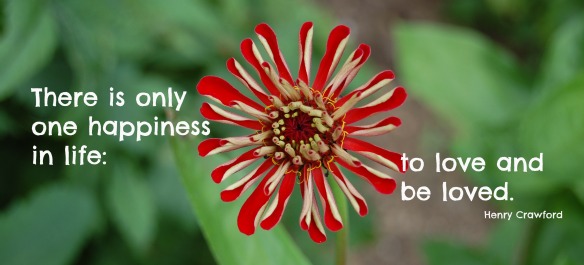
Little did I know that when I started to delve into the world of Jane Austen as part of a Christmas present for my wife, I was going to run in to an important theological concept, one that is at the cornerstone of human relationships with God and others.  In the movie Mansfield Park, Henry Crawford tries to woo Fanny Price using this profound truth: “There is only one happiness in life: to love and be loved.”

This profound statement rings true in fictional stories of far off lands and in the hearts and minds of every individual who ever lived.  Humans have an instinctive desire to love and be loved, to know and be known – to be in community.  And this stems back to, well, before Adam and Eve.

ToLoveAndBeLoved

It starts with who God is.  We worship a God who exists in three persons: God the Father, God the Son, and God the Holy Spirit.  Therefore, we worship a God who is in community.  And humans were created in the image of God – in community.

Genesis 1:26 states, “Then God said, ‘Let Us make man in Our image, according to Our likeness’” (NASB).

Through most of human history, many thought that being created in the image of God meant that we looked like God; that this referred to some physical quality.  However, within the last few centuries, theologians have found that being created in the image of God most likely refers to the relational aspect of our beings: our capacity to be in relationship with God and with others.

Consider Jesus’ response to the lawyer when he asked about the greatest commandment of the Law:

“Jesus replied: ‘Love the Lord your God with all your heart and with all your soul and with all your mind.  This is the first and greatest commandment.  And the second is like it: Love your neighbor as yourself.  All the Law and the Prophets hang on these two commandments’” (Matthew 22:37-40, NIV).

We are called to love and community because our identity is tied up within our need for relationship.  Therefore, right from the beginning of time, we were made to be in community: to know others and be known by others, to love and be loved.

We find purpose in community.  We find love in community.  We find God in community.

Jane Austen knew it.  And God created it.

Tim

Tim is living the newlywed life in Northern Idaho with his best friend, Emily.  He’s a triathlete, coffee connoisseur, and trumpet/guitar/piano player.  Seeing families connect with each other and with God is his passion.  He currently serves as the Youth Pastor at Coeur d’Alene Bible Church.

Blog | Twitter | Facebook